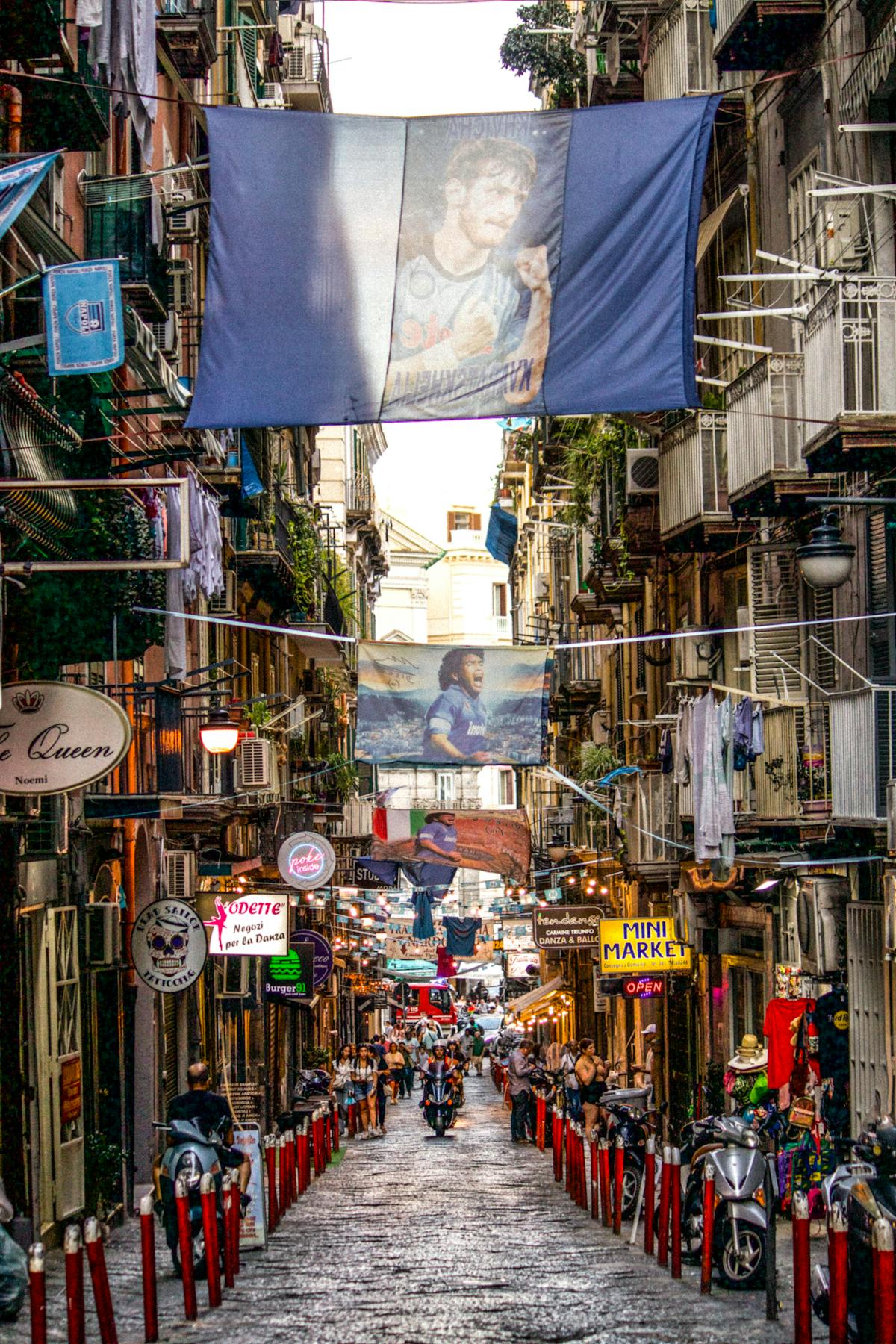
If you stand on the hill at Certosa di San Martino and look down at Naples, you'll notice something: there's a straight line that cuts the old city almost perfectly in half, east to west. That line is Spaccanapoli. The name literally means "splits Naples," and it does — running from the church of Gesù Nuovo all the way through the tangled guts of the centro storico until the street thins out somewhere near Via Duomo. It follows the path of one of three ancient Greek decumani, laid down when this city was still called Neapolis, roughly 2,500 years ago.
I walk some stretch of Spaccanapoli almost every day. It's on the way to everything — the bakery, the post office, the bar where I get my morning coffee. And every single time I think I know this street, something catches me off guard. A new shrine appears overnight. A guy sets up a table of old Maradona jerseys. A woman leans out of a fourth-floor window and lowers a basket on a rope to collect bread from the delivery man below. Allora, it's Naples.
What's Ahead
Start at Piazza del Gesù — Take a Breath
Most people begin at the western end, which means Piazza del Gesù Nuovo. It's a wide-open square dominated by the Guglia dell'Immacolata — a tall baroque spire covered in saints and angels that looks like it might topple over if you stared at it too long. Behind the spire sits the Chiesa del Gesù Nuovo, and this is where I always tell people to start, because the facade alone is worth five minutes of your time.
The front of Gesù Nuovo is covered in diamond-point rustication — rough, pyramid-shaped stones from the 15th century, left over from the palazzo that stood here before the Jesuits converted it into a church. Inside it's the complete opposite: gold, frescoes, marble inlay, the full baroque assault. There's a small chapel dedicated to Giuseppe Moscati, a doctor from the early 1900s who treated the poor of Naples for free. His story is one of those things that sneaks up on you — you walk in expecting architecture and walk out thinking about something else entirely.
Across the piazza, directly facing the church, is Santa Chiara. And if you only have time for one thing on this walk, basta — make it the cloister.
Santa Chiara and the Cloister That Stops You Cold
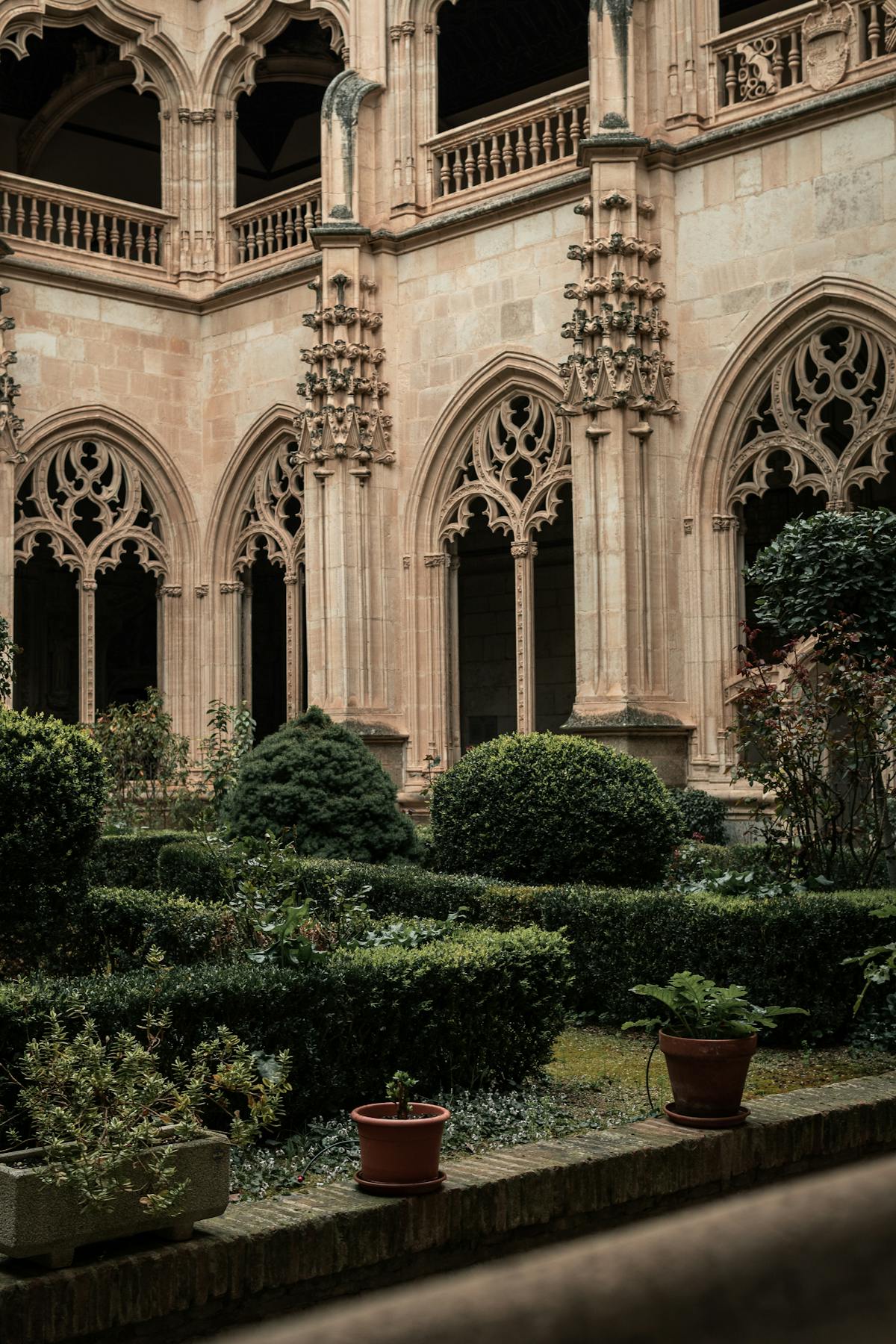
The Complesso Monumentale di Santa Chiara was built in the 1300s for the Angevin rulers of Naples. The church itself was bombed in 1943, rebuilt afterward, and now has this stripped-back simplicity that feels more honest than most baroque churches in the city. But the real reason you're here is the Chiostro delle Clarisse — a garden cloister lined with majolica-tiled columns painted in yellow, green, and blue, depicting grape vines, rural scenes, and daily life in 18th-century Naples.
Marco's take:
I brought my grandmother here on her first visit. She grew up ten minutes away in the Quartieri Spagnoli and had never been inside. She sat on one of the benches for about twenty minutes without saying anything, which — if you knew my grandmother — is basically a miracle. There's something about the quiet in that cloister, right in the middle of the loudest city in Europe. You step back outside and the volume hits you like a wall.
The entrance to the cloister is around the left side of the church (not through the main doors). There's a small museum attached and a surprisingly decent gift shop. Budget about 30-40 minutes for the whole complex.
From Santa Chiara, walk east. The piazza narrows into Via Benedetto Croce — named after the philosopher who lived on this street — and this is where Spaccanapoli officially begins to feel like itself. The buildings close in overhead. Scooters appear. The noise goes up by about 40 percent.
The Part Where You Smell Fried Dough
Somewhere between Via Benedetto Croce and its eastern continuation, Via San Biagio dei Librai, you're going to smell it. Oil, dough, something sweet, something savory — hard to tell at first. That's the smell of Spaccanapoli in its purest form, and it's coming from everywhere: the friggitorie (fried food shops) that have been here for decades, the pizza-a-portafoglio stalls, the pastry shops pushing sfogliatelle through tiny windows out onto the street.
Along this stretch you'll also notice the edicole votive — the street shrines. They're everywhere in Naples, but on Spaccanapoli they're particularly dense. Little glass cases set into the walls, holding statues of the Madonna or various saints, surrounded by plastic flowers, rosary beads, sometimes a photo of someone who's passed. Some are centuries old. Some were put up last month. Many have small electric lights that stay on all night. They're not decorative. People actually stop and pray at them, crossing themselves as they pass. A guy on his scooter will slow down, touch his hand to his chest, then gun the engine and disappear.
There's a particular stretch near Palazzo Venezia where three shrines sit within thirty metres of each other, each maintained by a different family. The flowers are always fresh. It's one of those things that reminds you: this street isn't a museum. People live their entire lives along this line.
The street itself changes names as you walk east — Via Benedetto Croce becomes Via San Biagio dei Librai — but the vibe is continuous. Shops selling coral jewelry, old book dealers, places where you can buy a hand-painted tambourine or a ceramic horn (corno) to ward off bad luck. It's a lot. In the best way.
San Gregorio Armeno — Christmas All Year Round
About halfway along Spaccanapoli, you'll hit the intersection with Via San Gregorio Armeno, which runs perpendicular, heading north toward Via dei Tribunali. This is the famous presepe street — the one lined with workshops that make nativity scenes year-round.
And I mean year-round. In July, in the middle of a heatwave, there will be artisans in tiny workshops hand-painting shepherds, carving miniature fruit stands, and wiring LED lights into cork-and-plaster recreations of Bethlehem that look suspiciously like the Quartieri Spagnoli. The Neapolitan presepe tradition goes back to the 1700s, and the figures aren't limited to biblical characters — you'll find Maradona, Sophia Loren, current politicians, pizza makers, and the occasional Pulcinella crammed in next to the three wise men.
During November and December, Via San Gregorio Armeno becomes essentially impassable. Shoulder-to-shoulder crowds, zero personal space, the smell of roasting chestnuts mixing with incense from the church. If you can handle the chaos, it's worth seeing during the Christmas season. If you can't, go any other month and you'll still see everything — just without the crowd.
A Quick Detour to Cappella Sansevero
Just north of Spaccanapoli, a two-minute walk up a side street, sits the Cappella Sansevero. It's small — barely a chapel — and it contains the Cristo Velato (Veiled Christ), a marble sculpture from 1753 by Giuseppe Sanmartino that is, genuinely, one of the most remarkable things I've ever seen. The veil draped over Christ's body is carved from a single block of marble, and it looks like actual fabric. People stand in front of it with their mouths open. I did, the first time. I still do, sometimes.
The rest of the chapel is equally strange and beautiful — the alchemical machines in the basement, the anatomical models, the ceiling fresco. Raimondo di Sangro, the prince who commissioned it all, was either a genius or completely mad. Probably both. Dai, just go. You'll understand when you're inside.
Marco's take:
Buy tickets online. I cannot stress this enough. The chapel is tiny, they limit the number of people inside, and the walk-up line regularly stretches around the block. I've watched tourists stand in that line for over an hour in August heat. Book a morning slot on the official site, show up five minutes early, and walk right past everyone. It costs the same either way.
Where the Street Runs Out
East of Via San Gregorio Armeno, Spaccanapoli continues as Via San Biagio dei Librai, passing old palazzi with massive stone doorways, more shrines, more shops selling lucky charms and coral necklaces. The street eventually thins and loses some of its intensity as you approach Via Duomo. Some people keep walking east from there, but honestly, the heart of the walk is between Piazza del Gesù and San Gregorio Armeno. That's where the density is highest, where you'll eat the most, where you'll take photos you didn't plan on taking.
I've lived in Rione Sanità for two years now, and Spaccanapoli is still the street I take people to first. Not because it's the "best" of Naples — boh, I don't even know what that means — but because it's the most compressed version of the city. Twenty-five centuries of building on top of building, shrine next to bar next to 14th-century church next to a guy selling counterfeit handbags off a blanket. It's loud, it smells like ten different things at once, somebody will probably bump into you, and there's a very real chance you'll eat something life-changing from a paper cone while standing in the middle of the street blocking a scooter.
Spaccanapoli doesn't split Naples in two. It holds it together. Everything in the centro storico refers back to this line — the churches face it, the side streets drain into it, the daily rhythm of the neighbourhood follows its length from west to east and back again. You can visit Naples without walking it. But I wouldn't recommend that.
For more context on the broader centro storico and the layers of history underneath it, Lonely Planet's Naples overview is a decent starting point, though nothing replaces getting lost on the actual street. And you will get lost. That's sort of the whole point.